Elektron website, the third
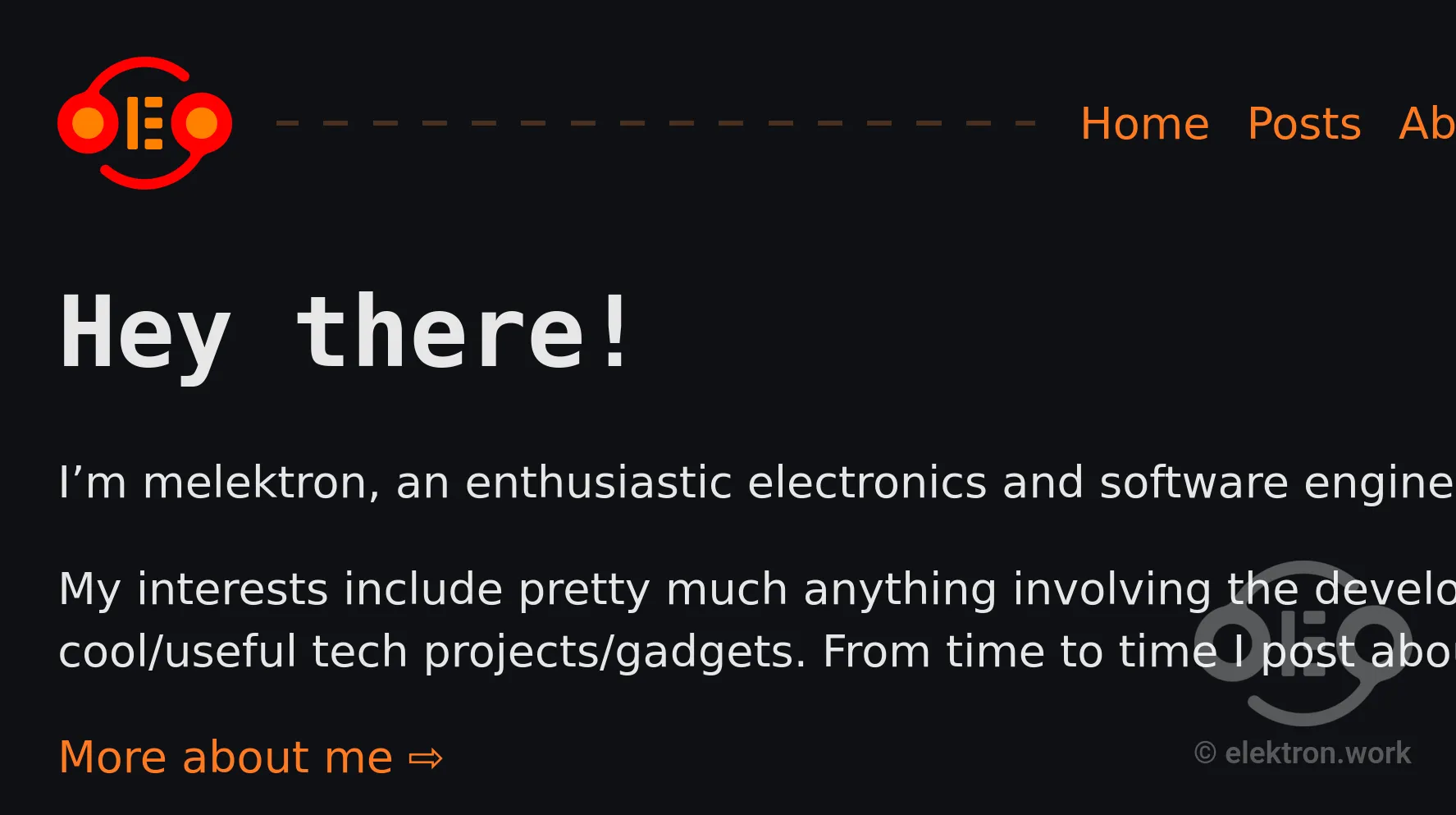
History
One of my longest running, still active projects has to be this website (elektron.work) itself.
It started some time in 2017 when I learned how to create static webpages with HTML from a YouTube tutorial. With the help of my parents, for the first time I was able to publish it to the internet for everyone to see. Though a nice first project, I quickly learned that to actually publish content, a static, hand-coded HTML page was rather impractical, so soon after we switched to using the free Content Management System GetSimple CMS, which was one of the options supported by our hosting provider easyname. Some more (mostly exemplary) content about projects I was working on followed, including pictures in the gallery. Fragments of this were documented in an old blogpost and project page.
However, my interest in documenting and “archiving” projects hadn’t yet developed at the time. When I became more aware of the value it provides, I had already learned a lot more about technology. Compared to the light-weight Markdown files I would use to write GitHub READMEs, the “old” PHP based GetSimple CMS ended up being more of a hassle than helpful when it comes to actually publishing content. All this lead to radio silence over the last years, except for the occasional post when someone was able to persuaded me to publish nonetheless.
Migration to Astro
All this changes now, as I recently (June of 2026) removed the old website based on GetSimple CMS in favour of this new, Astro-based site. Migrating away from the old system was on the ToDo list for a long time for the aforementioned reasons, but I hadn’t found enough motivation to do it.
The migration was finally kickstarted a few months ago (beginning of 2026) by the end-of-support for PHP 7 by my hosting provider. I upgraded to PHP 8, but the old install didn’t support it, leaving the page in a broken state for some time. Instead of fixing it, I took this opportunity to finally do the migration.
This is not only a technical change, but also a stylistic and structural one. Many concepts of the old system originated from experimentation when I first got started creating websites and were redundant or not really used. The new website is both much more streamlined in terms of structure and much more flexible for future expansion.
As part of this change, I also changed my main publishing language from German to English, which I feel much more comfortable writing in. All my other online presences (GitHub, …) already were in English, as well as some of the more recent posts.
Conceptual changes
Some functionality of the old website doesn’t exist anymore:
- Welcome page
- search
- gallery
Old links pointing to these pages will instead redirect to this post.
The split between project pages and blog posts on the old website also doesn’t exist anymore. Instead, these concepts have been merged, resulting in the new “Posts” concept. It’s basically a blog, except that blog posts can be associated with each other (e.g. when belonging to a project or for follow-up posts). Associated posts will then show some sort of index at the top, linking to other associated posts. Currently there is no RSS feed for these new posts, though I am working on implementing this as well.
Existing projects and blog posts have been migrated in a way to that preserves their previous relation. Old links to these elements should redirect to their new equivalents for the foreseeable future.
In the future I may even translate and migrate existing content for ongoing projects to better fit in with new associated posts.
Technical improvements
The entire publishing pipeline is now much more streamlined and automated than it was in the past. For example, images are now automatically watermarked and stripped of all unnecessary metadata.
The migration of old content is also completely automated using a script, so if I decide to change anything about their presentation in the future, I can do so with relative ease.
The process of publishing has now been reduced to creating a new markdown file with the appropriate frontmatter, adding raw images to the appropriate directory and starting to type. No more fiddling with unscoped styles and fragile HTML elements in unstyled text boxes to achieve the desired style.
When done, running a single command compiles everything to a static bundle and deploys it to the hosting provider. In the future I will probably offload this step to CI to make it even easier.
These are not revolutionary changes, but it’s enough to significantly reduce the effort for publishing.
Closing words
With this change finally completed, I am hoping to publish more in to future. Until then, I hope you enjoy the new layout.